
The Growth Mindset – What it Actually is.

Seemingly a buzzword these days, the growth mindset seems to be put into many organisation policies and values statements, but what is the growth mindset actually? How do we, as individuals, teams and organisations achieve a growth mindset for ourselves or our teams and get our inner processes to flow in accordance to it?

The growth vs fixed mindset.

A fixed mindset is simply when we believe our skills, intelligence and abilities are fixed traits and that we cannot develop them. We see this quite often, with organisations buying-in costly talent instead of developing the skills of existing employees. Believing that success is dependent on talent alone could mean failure for individuals with the ever-changing career landscape due to the introduction of newer and developing technology.

Having a growth mindset means individuals believe their talents can be developed through hard work and developed strategies. This also means that organisations develop their employees through skills development and training, putting in processes to assess potential and develop talent to the employee’s individual traits. This contributes to long-term growth, with employees feeling empowered and committed.

How to develop a growth mindset.

For individuals, it starts with understanding that abilities and talent can be learned. Depending on your talents, some abilities can take longer to develop than others, but through hard work and commitment, talents, abilities and skills can be developed. Taking charge of your learning journey through continuous learning not only personally helps you learn more, but grabs attention of potential employers.

For organisations, it’s developing processes that centre around developing employee talent, through skills development and training. This could be learnerships and apprenticeships, (which contribute greatly toward your B-BBEE scorecard) or through soft-skills training. There are a great amount of options and benefits available when looking to implement skills development into an organisation. Get in touch here for an overview on the processes and benefits.

The misconceptions of the growth mindset.

Hearing the term “growth mindset” comes with a few misconceptions such as: “it is just about rewarding and praising progress” or confusing it with by being open-minded about different opinions and developing processes. It is in reality, more than this. It is about implementing genuine practices that develop talents, abilities and skills for long-term benefits.

Developing employees skills through training that is relevant could avoid costly talent buy-ins at a later date. Developing ones own skills and abilities contributes greatly to employability and career progression. These are outcomes that proceed any short-term rewards and gratification.

In short, the growth mindset encompasses long-term and sustainable goals, rather than short term rewards.

Looking to up-skill?

Mind the Gap Solutions offers Skills Development and Training for individuals and organisations. With 180 soft skills courses and accredited learnership options, get in touch for an option that suits you or your organisations needs.

We also offer psychometric assessments for talent management, career planning and personal/professional development.


Get in touch here.

View our website here.

Getting Back On Track – 4 Tips For Reevaluating Your Goals.

During the worldwide pandemic crisis, it has been easier than ever to become disconnected from our ambitions. So many of us have been forced to put our plans and goals on hold until a later date, with immediate plans having to adapt to the situation and circumstances at hand. In many instances it would be imperative that we reevaluate our goals and adapt our plans indefinitely. Here are four tips to get back on track:

How have your immediate circumstances changed?

Many people have been forced to take salary cuts, some have been retrenched, some are working longer hours due to being on the front-line. Almost everybody’s lives have been affected in some way or another due to the pandemic. Taking a look at the way your life has been affected and honestly considering how your immediate circumstances have changed is an important step in reevaluating your goals, and reconsidering them appropriately. Once you have a good, honest idea of where you stand currently, you are able to plan your steps and implementation of your goals properly.

How adaptable are your goals to your current situation?

Looking honestly at your original goals and determining how adaptable they are is a good way to start the reevaluation process. If you’d set a goal to start your further education this year and been set back by university closure or are unable to travel long distance, it would mean that this goal would be unattainable in this current time at first glance, however adapting it to suit your immediate needs, such as finding an online learning alternative for the time being would help you in reaching your goal.

How realistic are your goals to your current situation?

Understanding that your current circumstances may have changed, realistically obtaining certain goals may prove to be more of a challenge than others. If, for instance, your goal was to travel overseas it may be difficult to do so right now, making this goal unrealistic to the current circumstances at hand. Realistically setting a new date for the goal or replacing it with another one may be the best course of action when reevaluating.

Don’t forget to set some realistic grounding.

The best way to get things done are to set deadlines. Although difficult in some cases, it is always a good idea to set an estimate time for when your goal needs to be reached, carefully considering how realistic it is. If you have started a business that currently has 20k turnover monthly, setting a goal to make 900k turnover monthly in two months time will be unrealistic. Understanding the current market as it stands and knowing that slow and steady growth is essential to long term goal fulfillment is key.

We would like to hear from you.

Let us know what you think in the poll below.

Mind the Gap Solutions offers soft skills training and short courses for personal and professional advancement. We also offer turnkey solutions to all B-BBEE, EEA and SDA related legislation. Contact us here. Have a look at our comprehensive services here.

The key benefits of hiring young talent.

According to statista.com, the unemployment rate of youth in South Africa reached 53.18 percent in 2019 and the unemployment rate of youth climbed in Q1, with youth accounting for 63 percent of the total unemployed population according to statssa. This poses a problem to both youth and companies looking to adapt.

With these statistics growing annually, and in honour of Youth Day, it’s now more important than ever to explore the benefits of employing young talent.

They offer a fresh perspective.

With the rise in changing customer perceptions through millenial buying patterns, younger workers understand the trends and technology associated with it. They offer fresh perspectives on targeting new clients and bring new energy to the workplace, ultimately contributing to overall diversity.

Easier onboarding.

Younger individuals adapt better, and would contribute toward an easier onboarding process, by getting them familiar with company processes and procedures more quickly.

Training, up-skilling and workforce development.

Training younger employees and unemployed youth through learnerships and apprenticeships not only contributes toward your Skills Development spend on your B-BBEE Scorecard, it develops your workforce. Ultimately it aids in training youth to become leaders in their respective fields and if unemployed learners are absorbed, they contributes towards better productivity and further points on the Scorecard.

Affordability.

Studies show that it is more cost effective to grow your workforce than to buy in talent later on. Learnerships and apprenticeships are beneficial for both companies and youth, with the benefits for companies ranging from stipend payments to tax incentives, with reports that employers are able to recoup their training spend within two years.

Adaptability.

According to a study made by sciencedaily.com, younger people adapt easier to sudden change. With technology rapidly progressing and the corporate landscape changing to adapt to those changes, it is beneficial that our workforce is able to easily move forward and adapt with it.

www.mindtheapsolutions.co.za

Are you looking to hire young talent? Do you need a Training Provider or a B-BBEE advisor?

Mind the Gap Solutions offers Recruitment Services, Skills Development and Training and B-BBEE advisory, design and implementation. Get in touch with us here for information on the comprehensive services we offer South African businesses.

Responding to Criticism.

Criticism can come in many forms today, with the rise of online services and marketing, we don’t only receive criticism from our peers and superiors, we can receive it online from sources we don’t particularly know personally. How do we deal with criticism both in person and online without it having a negative impact on our creativity or productivity? Here are a few tips:

Focus on the problem, not the person.

Sometimes, criticism isn’t based on bad intent. There may be people in our lives or online looking to constructively give their opinion on what changes you could make to positively impact the outcome of your work. Focusing on the problem they present and looking at it objectively could help you improve your technique. Even if it stirs up a few negative emotions when first being confronted with the criticism, take your time and turn your focus on the problem, and not the person it came from.

Don’t react, rather respond.

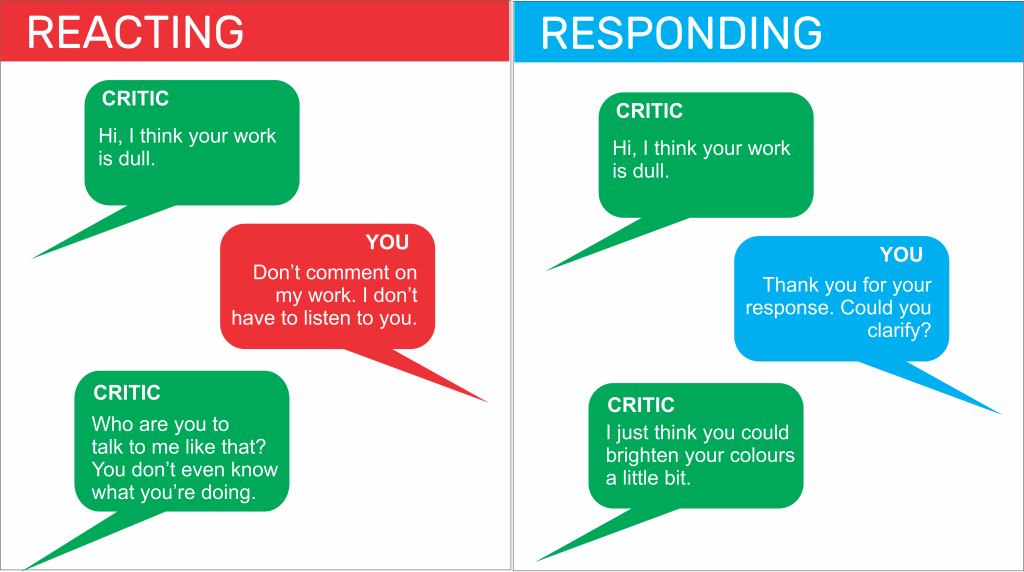
There is a big difference between reacting to an unsolicited comment and responding to it. Reacting is based on the immediate emotion it presents. Responding is collecting your thoughts and replying with a measure of mindfulness. Reacting sometimes causes a chain reaction, with the person delivering criticism perhaps becoming more negative with each attacking response. Here is an example:

Keep in mind that you can be selective with the advice you receive from anonymous critics, but responding with mindfulness could keep negative exchanges to a minimum.

Don’t take it personally.

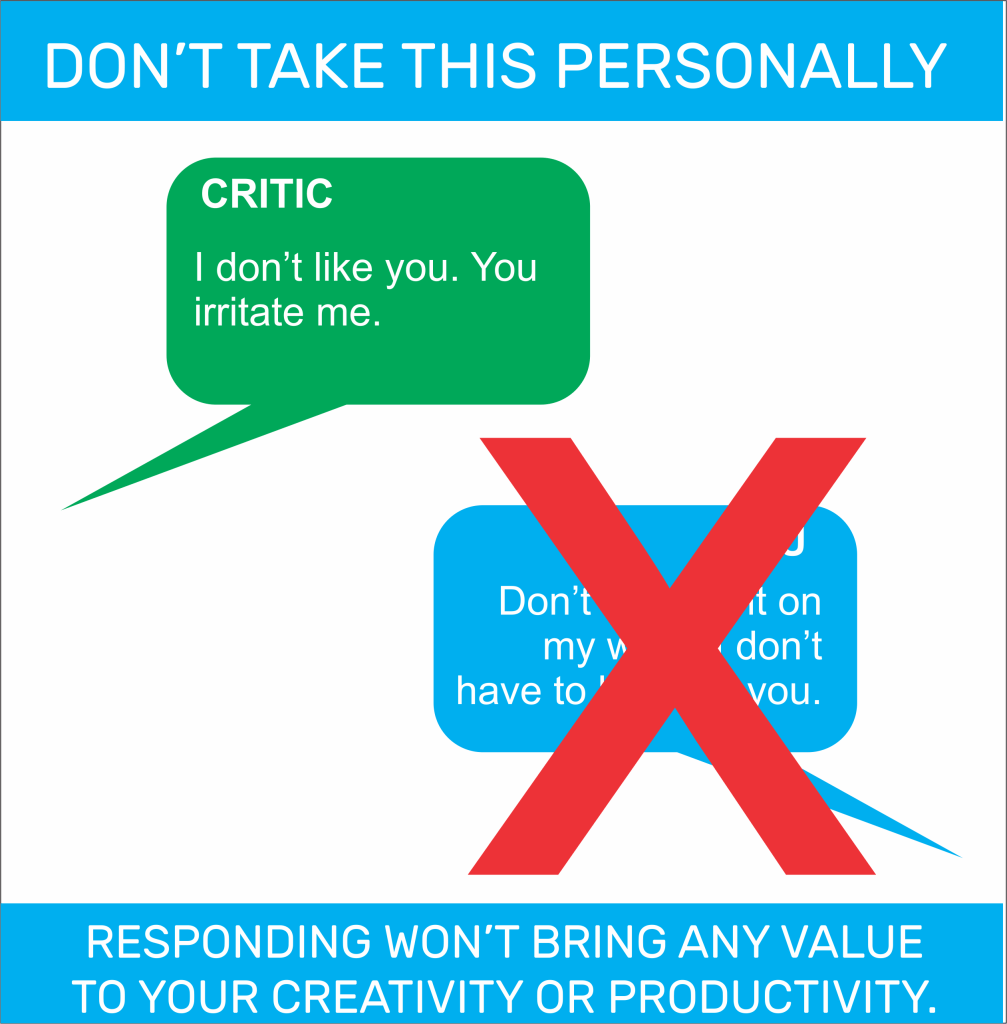
Sometimes, especially online, we could encounter criticism that has no meaning behind it. With the ability to remain anonymous online, anyone could make a comment that could be demeaning or personal with the intent to reduce your creativity. Gathering your thoughts and not taking these comments personally is the best way to overcome them. Comments like these in particular require no response, allow yourself to realise that the commentator is venting their personal frustration and that it may not bring value or be relevant to improving your work:

Consider the source.

When we receive criticism from anonymous individuals online, we have the freedom to be selective about what we take note of. This changes however if we’re receiving criticism from a superior, colleague or customer. It’s important to actively listen to the individuals directly involved with your work to understand how you can improve and avoid any conflict in the future.

How do you handle negative criticism?

Would you like to further your soft skills? Mind the Gap Solutions offers short soft skills training for teams and individuals. Get in touch here for more information. View our website here for a look at the comprehensive services we offer South African businesses.

What’s your learning style?

The importance of lifelong learning cannot be understated, learning is imperative to growth, both professionally and personally. However, sometimes, we can be put off by learning new skills because we find it difficult to grasp certain concepts.

There is, however, a way we can learn better. By assessing our unique learning style, we can accommodate our own learning needs to learn better and grasp both simple and complex concepts easier. Below is a list of the different learning styles, here you can read through them and see which are applicable to the way you learn and apply them to your own learning journey.

The visual learner.

Also known as the spatial learning style, you take in information better when seeing pictures, images and videos. You may find it difficult to retain information by exclusively read books that contain no images to accompany the words. When learning, it’s recommended that you draw visual cues to help you in retaining your information or finding video-related clips to aid in better learning.

The aural learner.

This is also known as auditory-musical learning style. Aural learners grasp information better when it is presented in the form of sound. This technique is commonly used in learners learning how to read, by clapping and sounding out phonics to a tune to aid in the better in-take of information. If you are an aural learner, you can create short musical tunes to key pieces of information to remember them better.

The verbal learner.

Also known as the linguistic learning style, verbal learners prefer both spoken and written words to learn. Most learning we come across will be in the form of the linguistic learning style, where we receive text books to learn from, go to course training or sit in classrooms and lectures. If you are a verbal learner, you’ll do well when reading more and listening to more lectures related to your learning topic.

The physical learner.

Known as the kinesthetic learning style, physical learners prefer using their sense of touch to learn. Physical learners learn better by doing physical tasks related to the topic at hand and utilizing classroom activities to learn. If you are a physical learner, doing a practical activity about the topic at hand will help you retain the information better.

For in-depth and comprehensive training, Mind the Gap Solutions offers short courses and soft skills training for individuals and teams. Get in touch with us here to find out more information on how you can book. View our website here for an overview of the comprehensive services we offer South African businesses.

Why soft skills are so important to career advancement.

Soft skills are widely talked about in the business world as a needed element. But what are soft skills, and why are they seen as so important in the working world?

What are soft skills?

The definition of soft skills are “personal attributes that enable someone to interact effectively and harmoniously with other people.” This means that they are personal traits and behaviours that enable us to relate and work with others. Soft skills are also known as transferable skills and are a part of the recruitment process, where recruiters would look at the personality traits of the candidate to determine whether or not they would be a good fit for their team.

Why are soft skills important?

While hard-skills are important (technical and specific knowledge of an area or field, such as a diploma or degree), almost every job is not limited to only this, it also requires a form of people skills, whether interacting with colleagues, team members, supervisors or customers. This can also be said for junior roles, where candidates are chosen not exclusively by their experience or qualifications, but by their potential to become leaders, which requires a growth mindset and self-motivation from candidates. Simply put, a productive and healthy workspace requires soft skills to function.

What are some examples of key soft skills?

Communication. Without the ability to communicate appropriately with others, candidates would not be able to comprehend their instructions efficiently, and not adjust their style and tone to their audience, and not explain key issues to colleagues and clients.

Self motivation. Being able to work with ambition and motivation aids in productivity and demonstrates reliability and commitment. It shows that you are able to work efficiently within the workplace structure without the constant need of supervision.

Responsibility. Taking responsibility and accountability for your own work shows aids in trustworthiness and shows a form of discipline when it comes to your own work ethic. This also includes taking ownership of your own goals and actively working toward them which directly ties into self-motivation.

Leadership. Leadership is a soft skill you can have even if you are not in a leadership position. Candidates with good leadership skills empower others and take the lead when issues arise. They have a positive outlook, great communication skills and make effective decisions.

Conflict resolution. Conflict is sometimes inevitable. The ability to resolve conflict when it arises by taking accountability and using good communication strategies is an important soft skill to have. It increases rapport with both colleagues and clients.

Can I learn soft skills?

Soft skills are unique, there is no exam that you can write to obtain them. Soft skills can, however be learned through training and practice. Mind the Gap Solutions offers soft skills training for career advancement. Whether you’re just starting out in your career or looking to up-skill your employees, we have training that can cater to your needs. View our website here for an overview of our services. Get in touch here for more information.

Are you starting a new business or project during lockdown? Here are a few tips.

Starting a new business has always had it’s challenges, and now with the added challenge of lockdown during COVID-19, starting a new business or project can be daunting. This however, hasn’t deterred many hopeful entrepreneurs who despite the added hurdles have decided to go ahead and start their new business. This could be for a number or reasons, including retrenchment. According to a recent insight posted by the NYTIMES, the pandemic may be the right time to start a business with the right idea.

Here are a few tips to get you started:

Adaptability is key.

We’ve heard phrases describing the “new normal” and what life is projected to be like after the pandemic. However, we can only project and analyse these statistics based on the information we currently have available. The ability to adapt your business to new changes is the key to thriving during ever changing circumstances. Setting up a business structure that supports the adaptability factor is the difference between just surviving and thriving.

Listen to your target market.

With potential clients focusing their energy on saving money and staying safe, pushing products onto clients that aren’t necessarily deemed a necessity may not be the best idea to get your business on track. Aggressive and expensive marketing campaigns won’t work if your products don’t serve an immediate purpose or solve a current problem. Understanding your target market better by finding out what their immediate needs are is crucial to generating sales and gaining leads. This doesn’t necessarily mean niche markets don’t do well, by simply adapting their business model around clients needs, they are able to thrive. Doing surveys directed at leads and clients and actively listening to their immediate needs with the intent of providing a service that solves those needs is key.

Online spam and scams.

While it is essential that your business is online, whether simply having a contactable email address and viewable website or a fully functioning e-commerce store, clients are now becoming more wary of online scamming and spamming and avoiding businesses that seem suspicious by the impression of their marketing campaigns. While you as a business owner should be aware of scams, you should also be aware of the impression you make when marketing your own business. Watch out for comments made on ads and view them objectively, this will determine how well you’re presenting your brand to the world.

Sending well wishes to all.

We would like to hear from you. Take part in our poll below.

Mind the Gap Solutions offers soft skills courses for professional and personal development, aimed at educating, empowering and transforming. Sign up here for our monthly newsletter. View our website here for a look at the comprehensive services we offer South African businesses relating to B-BBEE, EEA and SDA related legislation.

Business communication – what is effective when talking to clients?

Clients are the most important part of our business structure, without them, business won’t survive or thrive. Quite often, we’re taught to base our customer relations on “never say no” or “say it with a smile”, often presenting ourselves as disingenuous or generic. According to a survey done on study.com, with times changing many potential clients value quick, knowledgeable service with good after-sales support. The times of long, drawn out in-person conversations with the intent of convincing a client to buy your product or use your service now being long in the past, due to the increasing prevalence of online marketing and online communication. How then, can we effectively communicate with our clients in a genuine way that remains relevant to the immediate needs of clients today?

Avoid business jargon where possible.

Although professional sounding, excessive use of business jargon should exclusively be kept between colleagues and team members. Studies show that clients who are exposed to business jargon they don’t understand have higher chances of misinterpreting the actual message being conveyed. This can lead to frustration and a partial sense of inadequacy, giving clients a sense of passive arrogance coming from the representative. Keeping it light and short, using jargon in understandable, meaningful ways will help diminish the chances of misinterpretation and misunderstanding.

Be human and try to relate.

Empathy and active listening are two traits that form part of an effective, open communication strategy. Being able to actively listen to the client’s concerns without invalidating them will aid in creating relevant solutions objectively, and may contribute not only to the up-selling of different services and products that will service their needs, but the ability to form meaningful working relationships with clients. This strategy may also include taking careful note of your body language when in-person and using relatable language when communicating online. The use of relatable words such as “thank you, sorry, please” could be furthered by phrasing them out such as “I am thankful”, “thank you kindly” “I do apologise”.

Take note of inclusive language.

It is known that the use of phrases such as “you did not” “you should have” may feel like a passive attack on a client for miscommunication and misinterpretation. Simply explaining the concept specifically and clearly is a better strategy in avoiding these situations, and opting for inclusive language that is significantly less personal and negative could diminish the chances of the client feeling “attacked” when situations like these do arise. Inclusive language could include phrases with the words “we, our, us” to remove the personal aspects of “you, your”. Language such as “Please take note of the following” or “Thank you for raising these concerns, here are a few possible solutions” can also be used and aids in better after-sales client support and less conflict.

Simply ask.

Sometimes, miscommunication can come from the client’s side, and trying to decipher what is said without clarifying clearly what is needed can lead to frustration. Asking clients politely to reiterate should be a part of an effective communication strategy, while taking care of the language used when asking for clarity. Getting clients to understand the purpose of clear communication will aid in better working relationships.

We would like to know what you think. Take part in our survey below.

Mind the Gap Solutions offers short courses that goes over these points and more to implement into our professional lives for career advancement. Sign up here for a calendar on our short course events. See our website here for a look at the comprehensive services we offer South African businesses.

Working from home? Here are a few tips to cope.

Working from seems to have come as a revelation to some, and a difficult change to adapt to for others. In a recent study done by mentimeter, that surveyed 1500 employees working from home, 56% of workers said that they feel as though their feelings and opinions were being acknowledged less in video meetings, and 23% of employees miss their face-to-face interactions with their colleagues. If you’re on the latter side of the fence, here are a few tips to help you cope with working from home.

Stick to your routine.

When working from home it becomes easier to put of your usual routine. Studies show that discarding your routine results in productivity decreasing and increases in procrastination. This has a domino effect, with people generally feeling overwhelmed by deadlines and scheduled appointments.

Know when to switch off.

When working from an office, we know when we start work and know when it’s time to knock-off. Working from home hardly imposes on these restrictions, with the ability to wake up at 3am to start working and switching off at 10pm just to get tasks done. Not being mindful of the amount of hours you’re working can result in burn-out, with more days needed off in-between to try and recuperate. Setting a set amount of time to do work helps improve your routine and keeps productivity consistent.

Communication is key.

Working from home doesn’t eliminate potential problems that may arise, in fact, it may amplify them in certain aspects. Communication is exceedingly more important when we’re not seeing our colleagues everyday. Being able to communicate freely, not only about concerns, but achievements no matter how small, is not only critical to productivity, but morale.

Take note of the amount of distractions you impose on yourself.

Working from home can amplify the amount of distractions we’re faced with. Statistics show that 30% of workers name their family members, partners and housemates being the number one distraction. Although external sources of distraction are not easily controlled, we do impose a good amount of distractions on ourselves. With the ability to check our social media feeds more frequently, it takes a good amount of concentration away from work being done. Limiting the amount of distractions you can control can help aid in productivity and lessen the chance of procrastination.

Let us know what you think. Take part in our poll below.

Mind the Gap Solutions offers soft-skills short courses and training for personal and professional advancement. Sign up here for updates to our short course calendar. View our website here to have a look at the comprehensive services we offer South African businesses. Get in touch here for more information on our services.

How to handle conflict when working remotely.

Conflict resolution can sometimes be challenging, it can be especially challenging if you’re working remotely. Some methods of online communication can leave a sense of ambiguity about how a person truly is feeling, often coming forth as cold and aloof. Email, for instance, within it’s methods of business professionalism leaves little room for emotive context. So how do we combat conflict when working remotely? Consider these tips:

Focus on the problem, not the person.

Trying to focus on the problem itself without passing judgement to the person who raised the issue helps view the problem from an objective point of view. This helps eliminate unnecessary disputes about defensive statements, and aids in productive problem solving.

“Problems are always solved when it’s you and me vs. the problem, and not you vs. me.”

Anonymous

Keep an open line of communication.

Often, when we’re overwhelmed by our email inboxes, we never really give thought to having a quick, casual chat with a colleague or team member who’s feeling unheard. Keeping an open line of one on one communication with team members on another platform other than email so that they can raise their concerns goes a long way in resolving conflict that arises, helping team members feel like they’re being heard confidentially.

“Explain your anger instead of expressing it, and you will always find solutions instead of arguments.”

Anonymous

Try to consistently have team meetings.

Whether you use Zoom or Skype, having a weekly conference call with your team and colleagues will help raise problems collectively. This lessens any confusion there may be about any problems that may have been already raised. This also helps team members communicate with each other openly, eliminating assumptions. Video conferencing helps put an emotive context behind certain issues to a degree, helping eliminate the aloof and passive manner of email and text communication.

Take time to encourage and celebrate each other.

In an office setting, there are a lot of informal chats that happen while making coffee or around the water-cooler, which was quite important for encouragement, support and celebration, whether it was a small thing like celebrating the end of the week or something bigger like congratulating someone for their birthday, we cannot underestimate the importance of those informal chats. While working from home, it may have a slightly bigger impact on those needing that little bit of encouragement or support, lessening frustration. Taking the time to celebrate those small end of the week achievements helps encourage employee morale, leading to less conflict stemmed from frustration and feelings of discouragement.

“When we fail to acknowledge and celebrate small victories, we get discouraged, and the flame inside us starts to dwindle.”

Kristen Koonce

In our quest for adapting to change it is important for us to keep learning. Sign up and get alerts about our soft skills courses here. For a look at the comprehensive services we offer South African businesses visit our website. Get in touch with us here for more info.

Design a site like this with WordPress.com
Get started