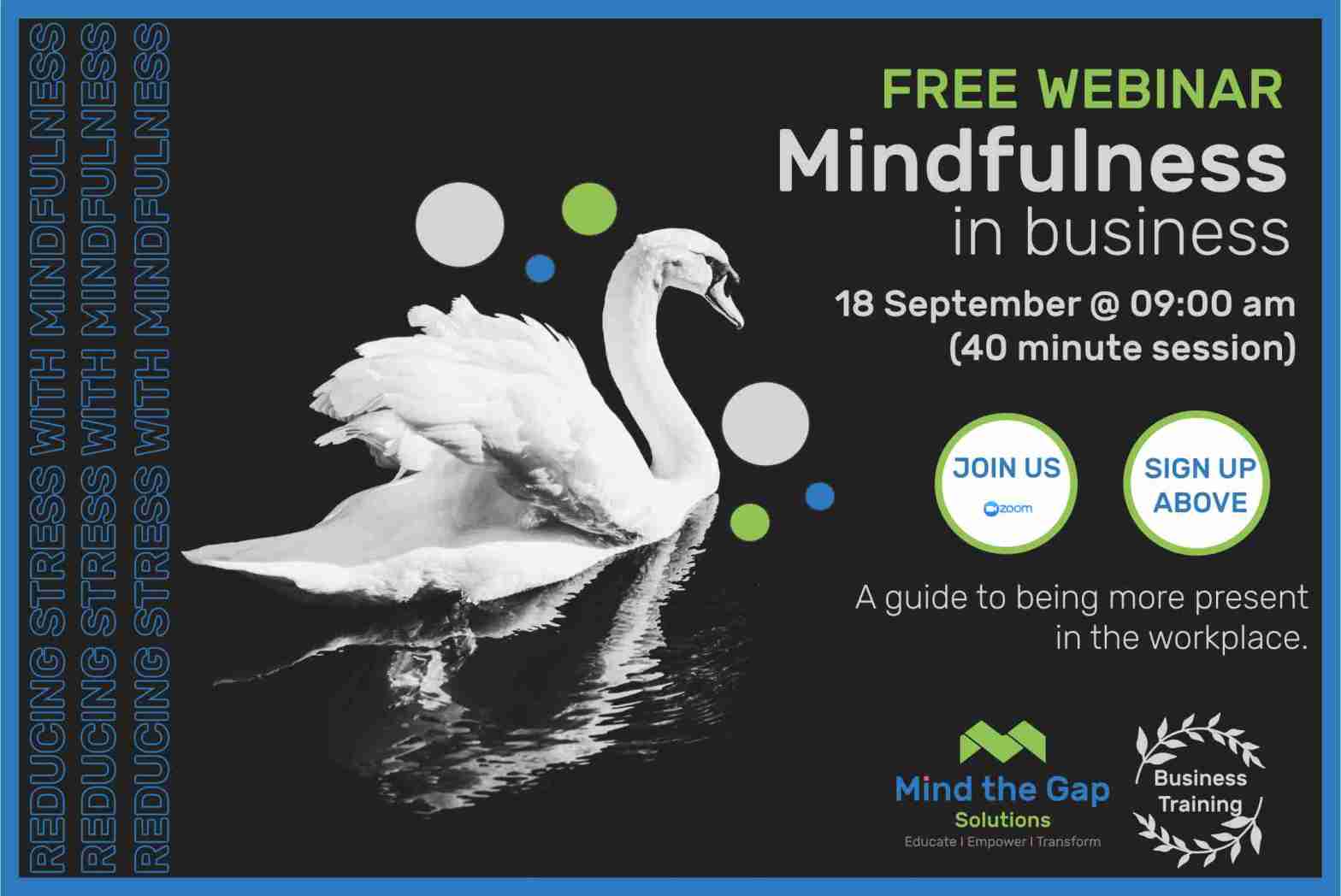
Mindfulness in business.

By now, some of us have heard the term, “be mindful”, but what does that mean when implementing it into a professional setting?

What is mindfulness?

Mindfulness can be defined as being in the state of awareness of the present moment, being consciously aware of what is happening and how you feel about the situation. Although we would often think we are being aware in the moment constantly, this is sometimes not true. We often think of the future, stressing about the deadlines we have to meet or the meeting we have to attend this afternoon, or we’re thinking about the criticism we received from our clients yesterday.

By doing this, we’re not experiencing the present moment, we’re either thinking ahead or about the past. Being mindful helps us be consciously aware of what’s happening right now and dealing with it at that particular moment.

Can we implement this in our professional lives?

Mindfulness is not just a trend or a term used broadly, many successful leaders in business use mindfulness techniques to overcome stressors.

Being able to manage large teams and still juggle a tight deadline schedule can be stressful, leaders implement mindfulness techniques to stay ahead and improve their problem solving and adaptability skills.

What are some of the common misconceptions of being mindful?

Being mindful is sometimes misunderstood with empathy, and while empathy is a part of being mindful, there is more to mindfulness than being empathetic with others. Mindfulness entails being present in the moment and observing the situation. Observing your own thoughts and feelings on the matter at hand objectively while being empathetic to those around you.

What will being mindful do to help me in my professional life?

Being mindful aids in overcoming stress and alleviating procrastination; because you are aware and observing the immediate situation, you are also able to problem solve more quickly and adapt to change better.

How can I achieve mindfulness in my professional life?

We’ll be discussing mindfulness techniques in our free webinar session on Friday 18 September at 9:00am. We’ll be discussing the techniques professionals use to remain mindful and in the present moment to overcome stress and improve their problem solving.

We’ll be unpacking some of the commonly used techniques such as active listening and self-realisation. Don’t miss out.

How to attend?

Sign up here to get the Zoom session link emailed to you.

Have questions? Get in touch here.

About us.

Mind the Gap Solutions offers BBBEE advisory, design and implementation, Employment Equity Consultation, Skills Development Facilitation services, Skills Development and Training, Soft Skills Training, Psychometric Assessments and Recruitment Services.

Get in touch with us for a consultation session on your needs.

Our website and contact details are here.

How to Problem Solve When You Get Rejected.

Everyone faces rejection and disappointment at some time in their lives, even some of the most famous business owners and individuals today have faced their fair share of rejection. There are many people who are now opening their own businesses and many who are job-hunting after lockdown. How do we properly face rejection and disappointment from recruiters and clients and solve potential problems that have been raised as issues when facing the rejection?

Be honest with yourself.

The first step in problem solving is being honest about the problem. What are you lacking and how are you going to gain the skills you’re lacking? Being completely honest about the issues you face is critically important to move forward, whether you’re looking to be recruited or own a business.

Ask for feedback.

Didn’t get that job? Ask why. Sometimes we walk away and dwell on the fact that we were rejected but don’t know why. Ask recruiters why they didn’t hire you to gain an understanding on what is generally looked for. Yes, sometimes recruiters seek someone specific, but many times their criticism of you can lead to learning what to do better in the next interview. This is true for businesses as well, listening to customer feedback, no matter how harsh, can help improve quality and service delivery.

Value and price.

There is a large amount of business owners that will tell you that if your product or service value isn’t right, your price will never justify it, no matter how cheap. The wrong target market will complain about price, the right target market will complain about quality and after-sales support. If clients reject your price while targeting the right market consider whether you are being competitive or not. If you cannot be competitive, assess your production process and suppliers. Problem solving is about getting to the root cause of the problem and not just solving it on a client to client basis.

Do you have a long-term vision?

Having goals written down is a great way to assess what long term visions you have for yourself or for your business. What are the obstacles in the way of you achieving your goals, and what are you doing to eliminate those obstacles?

Join our webinar.

Sign up here, we’ll be going into depth with the problems potential recruits and business owners face and tips on problem solving as issues arise:

https://mailchi.mp/ba23d2fbbf2c/problem-solving-webinar

Get in touch:

View our website here.

Email us here.

The Benefits of Learnerships for Employers.

By now, many South African companies are accustomed to the intricacies of holding Skills Development and Training initiatives in their respective fields for their employees and other unemployed learners.

But what are the benefits of Learnerships, how can they be implemented, and why, as a whole, do we have a need for Learnerships in South Africa. Let’s explore:

What is a learnership?

Learnerships are work-based training programmes that lead to an NQF registered qualification. They were introduced by the South African Government to up-skill learners and get them ready for the workplace.

Learnerships are specific to the occupation in mind, such as project management, general management and wholesale and retail operations and are a great way to train youth within that specific sector while upholding company policies at the same time.

While learnerships hold great opportunity for employees within a company to rise and hold better positions, it also offers opportunities for self-employment with the skills learnt from the learnership programme. Which in turn, sets a tone for a better economical strategy.

Why were learnerships implemented?

By transforming the way Skills Development was implemented in South Africa in the past, wherein there was a gap between education and practical workplace experience, learnerships aim to close that gap by placing an emphasis on practical workplace training.

With a specific aim in mind when implementing the Skills Development Act and the Skills Levies Act, which was passed in Parliament to transform and link theoretical practices and direct workplace experience.

The aim of learnerships is to: decrease unemployment by bringing equal and fair opportunities to unemployed youth and develop the much needed skills shortages found in South Africa.

How do learnerships benefit you as an employer?

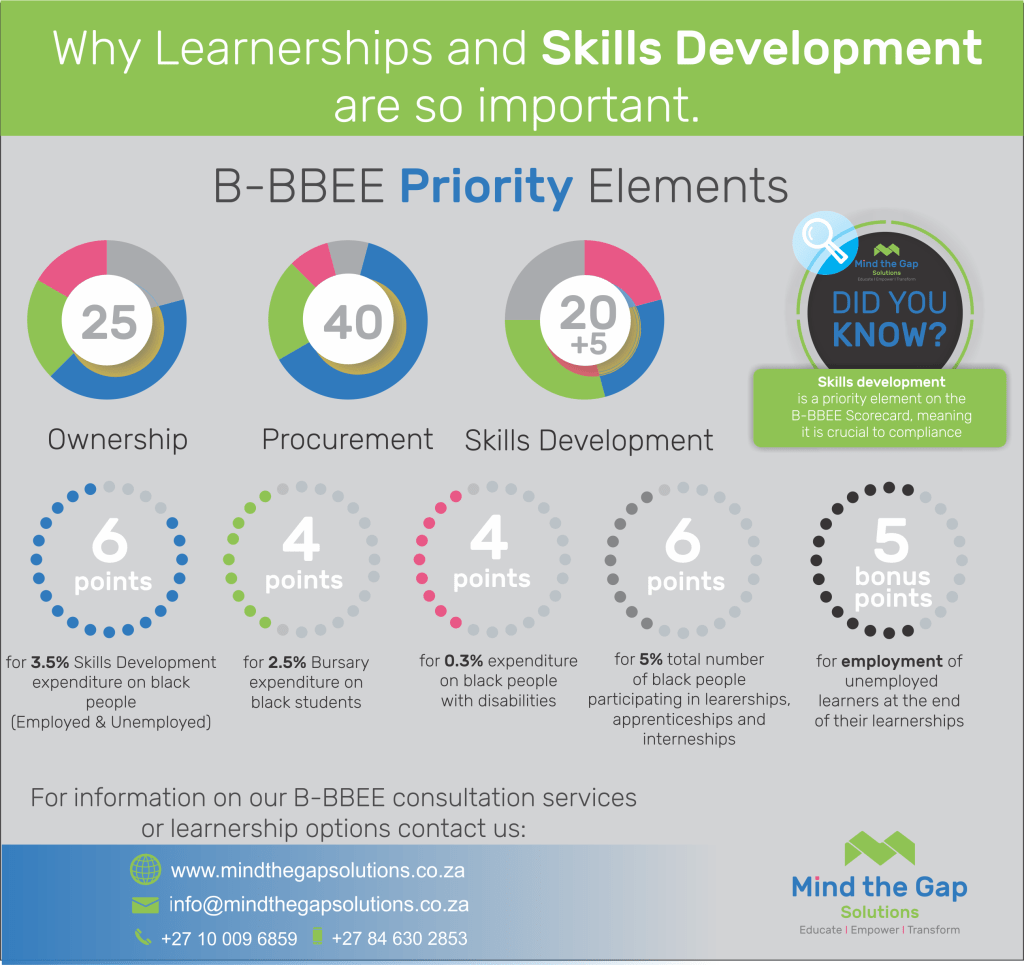
For employers, learnerships increase your B-BBEE Score on the Scorecard. As it stands, employers can benefit up to 6 points for registering black learners amounting to 5% of their headcount on learnerships.

This spend could also count toward the 3.5% leviable amount of training of black employees /learners for 6 points, and a further 2.5% for black learners with disabilities for 4 points.

There are also an additional 5 points available for absorption.

The benefits can also count for having trained employees within your workforce, which counts toward productivity and morale, without having to buy-in talent at a later date, which can be costly.

What are the consequences of non-compliance?

Skills Development is a priority element on the B-BBEE scorecard, and as such, failure to implement any form of Skills Development on the Scorecard could cause you to lose points, which in turn causes trade-sanctions and loss of opportunity for growth. Non-compliant entities also risk being dealt hefty fines.

How to implement a learnership?

Get in touch with us here. Mind the Gap Solutions has a wide range of solutions, from B-BBEE advisory, design and implementation to Skills Development and Training solutions. Let us set up a consultation session with you to better understand your needs and provide cost-effective, turnkey strategies and solutions.

Employment Equity- The Basics.

What is employment equity?

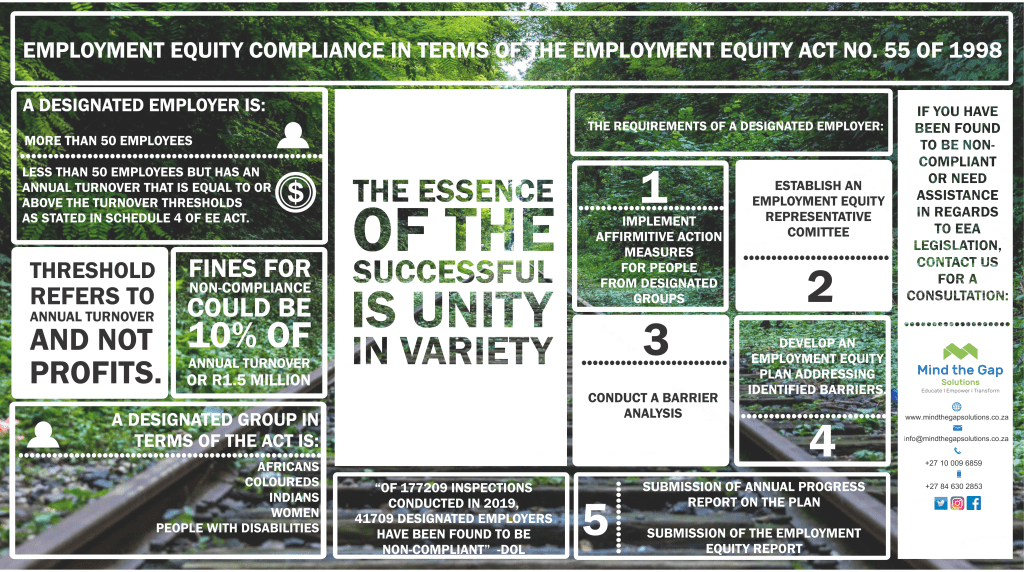
The employment equity act No.55 of 1998 ensures a fair and diverse workforce among designated employers.

Designated employers and groups.

A designated employer is either an entity with a headcount of 50 or more employees, or an entity that has fewer than 50 employees with an annual turnover that is equal to or above the turnover thresholds as stated in schedule 40 of the Act.

Turnover is counted as annual turnover of the entity and the profits are not counted.

A designated group in terms of the act is defined as Africans, Coloureds, Indians, Women and People with Disabilities.

What are the requirements of a designated employer?

  1. Apply and implement affirmative action measures for people from designated groups.
  2. Establish an employment equity representative committee.
  3. Conduct a barrier analysis.
  4. Develop an employment equity plan based off the barrier analysis addressing identified barriers.
  5. Submission of an annual report on the progress as stated in the plan, and submission of the employment equity report.

What the statistics say.

Statistics as issued by the Department of Labour in 2019 state that “of 177209 inspections conducted in 2019, 41709 designated employers have been found to be non-compliant.”

The consequences of non-compliance.

Designated employers found to be non-compliant are subject to fines estimated to be 10% of an entities annual turnover or R1.5 million.

Non-compliance could also mean incorrect use and untimely submission of the plan and report to the Department of Labour. Compliance includes making visible progress as outlined by the plan, thereby shifting from merely putting together a tick-box plan to impress, with clear strategies to carry out points stipulated on the plan.

Solutions for compliance to Employment Equity.

Having a trained consultant help you with your committee setup, EE plan and report could help entities avoid costly fines for non-compliance.

Get in touch with us here for a consultation session on your needs. We offer cost-effective, sustainable solutions to compliance with B-BBEE, EEA and SDA related legislation.

4 Tips for Business Startups.

There are many who dream of starting a business, but don’t know where to start. Besides business registration, capital, funding and accounts, there are other factors to consider when starting a business.

Here are the 4 top tips taken from successful female business owners and a link to our free webinar on Friday 7 August discussing these in detail and more.

Get a chance to introduce yourself and your business.

Subscribe here for a link to our webinar on 7 August. Hear the top tips for business startups and get a chance to introduce your business to the attendees.

Tip #1 – Listen to what others around you are saying.

If someone has an opinion about the direction of your business, absorb the information. Although not everyone’s opinions will be helpful, the biggest factor in business success is listening to clients and understanding what they need, even if you have to slightly tweak your business plan to fit in with your customer expectations.

Tip #2 -Address your inner voice.

There are times when we bring ourselves down, instead of uplifting ourselves and seeing the slow times through. Addressing the excuses as to why you can’t do something and addressing the inner voice that tells you that you’re not cut out for entrepreneurship is the first step in self-confidence about your business. Truly believing in your product or service comes from the entrepreneur first and then from the customers after.

Tip #3 – Take that risk – after understanding the pro’s and con’s.

“Failure is not failing at the task you set out to do, failure is not being willing to try.” Taking the risk and making it work to the best of your ability isn’t the definition of failure, we can learn from trying and failing. However, we can’t learn from not trying at all. Taking calculated risks can only be beneficial to your success, whether through learning from the experience or succeeding at what you set out to do. Calculated risks are determined through the brainstorming process to determine the pros and cons of the decision, being impulsive about decisions could land you in hot water, so be sure to understand what you’ll be getting yourself into.

Tip #4 – Keep learning.

Talk to any successful entrepreneur and they’ll tell you that despite how long their business has been running, they continue to learn. Being too complacent is dangerous. Everything you learn is an opportunity to improve your business, and nothing you learn is too “small” either. Whether you’re taking a short course on customer service skills or self-confidence, your business can surely benefit from it.

Remember to subscribe to our webinar.

Click here to subscribe. We’ll send you a link to the free webinar we’re hosting on zoom, Friday 7 August at 09:00am. Learn about these and more in our 45 minute webinar, and get the chance to introduce yourself and your business.

Mind the Gap Solutions offers short soft skills courses, B-BBEE consultation, Accredited Skills Development and Training, Psychometric Assessments and Recruitment Services. Click here to get in touch with us to inquire about our services.

The Important Role of Email in Business

Is email dead? Is it old news? According to a study made in 2019, there are 3.9 billion active email users globally.

The importance of email in business cannot be understated. It is still the preferred method of communication in professional settings, whether between colleagues or closing deals with clients. Due to social distancing, the rate of email being used in professional settings has increased significantly. With the costs of data being lower to send an email than being on a 30 minute call, many still use email as a default means of communication for business inquiries.

Email as a means for responsive interaction.

On average, professionals receive 120 new emails per day, and only respond to 25% of them, according to this study.

What makes the 25% different to the remaining 75%? The answer lies in the format. This doesn’t just apply to cold emailing either, this applies to responses to client inquiries as well. It’s no secret that at some point or another we’ve sent a response to a client inquiry and didn’t get a response back, despite follow-ups, this becomes more apparent when our product pricing was already made available to the client before the inquiry was made.

Being aware of how your responses impact client perceptions of you and your business could mean the difference between the 25% and 75%.

How do I know that I’m responding right?

There are various methods top client relationship managers and sales professionals use to close deals via email, and we’ll be highlighting those in our free to join webinar on 31 July at 09:00am.

Click here to register and receive the link via email.

We’ll be unpacking some of the biggest tips in formatting your email professionally, especially for client responses. It’s free. It’s only for 30 mins. It will make a big impact on how you format your emails for better response rates and better professional perception.

See you there!

What Top Business Leaders Do To Keep Productive.

When working from home or in the office, sometimes our productivity can dwindle, this can be due to a number of reasons like distractions, not setting goals, tackling too much work at once or not having set deadlines.

How then, do top leaders keep productive with the amount of work set out in front of them and how can we implement those strategies in our own careers? Here are a few tips:

Planning ahead.

Planning your days and the tasks you need to accomplish within those days aids in productivity and can be an effective tool in managing time. This also helps establish deadlines. Knowing what tasks you’re set out to do the following day helps immensely in our productivity and ensuring we do high-value tasks among the mundane ones sets us up for consistent productivity daily. This helps us feel as though we’ve accomplished and achieved something, other than going through our days just doing the bare minimum of what’s expected.

Tackle the most difficult task first.

Putting the most difficult task on the back-burner could cause productivity to dwindle, doing the most difficult tasks earlier in the day when our energy is at it’s highest helps us concentrate on them better. This also sets a positive tone for the rest of the day, knowing we’d accomplished the more difficult tasks already.

Know yourself.

Some people are more productive earlier in the morning, others are more productive in the evening. Knowing when you’re at your most productive and scheduling your tasks around this could help you be more productive. Honestly assessing when you’re most likely to procrastinate will be beneficial to understanding where your productive moments lie.

Getting started is the hardest part.

Procrastination occurs when we think about starting a project but end up not doing it. Most of us are guilty of procrastinating at some point. This usually happens when we’re either worried about the enormity of a task or we’re not stimulated enough to do the task. A good rule of thumb is to start the task for just five minutes, getting over the hurdle of starting.

Distractions.

Distractions occur, whether we want them to or not. There are distractions that happen outside of our control, such as a colleague wanting to chat about a problem, or a phone-call from a client unrelated to the task you’re currently doing. However, there are distractions that we can control. Limiting the amount of time we spend checking emails, updating our social media status, or just scrolling down and looking at posts and tweets could positively impact our productivity. According to studies the average amount of time individuals spend on social media daily is 2-3 hours. Limiting that time could help us complete tasks and tackle procrastination.

Mind the Gap Solutions offers soft skills training with over 180 courses to choose from, including time management and self-leadership.

Get in touch with us or view our website to inquire.

The Revised Lockdown Regulations – What Employers Need to Know.

With President Cyril Ramaphosa’s address to the nation on Sunday (12 July 2020), the revised directives have been published which outline South Africa’s new level 3 lockdown rules.

As an employer and business owner, it is vital to know and adhere to the revised regulations to curb the spread of COVID-19 amongst clients and colleagues.

Employers are to provide employees with masks/protective gear.

The Disaster Management Act of 2002, Amended regulations issued in terms of section 27(2) state that: (d) 3 (a): “An employer must provide every employee with a cloth face mask, homemade item, or another appropriate item that covers the nose and mouth while performing his/her duties.”

Employees are not allowed to enter their workplace without face masks.

(d) 3 (b) states that: “An employer may not allow any employee to perform his/her duties or enter the employment premises if the employee is not wearing a face mask, homemade item or another appropriate item that covers the nose and mouth while performing his/her duties.

Failing to comply could mean fines or imprisonment.

Amendment regulation 14 (6) and (7) state that failure to comply with the regulations or failure to take reasonable steps set out in 5(2)(a)(b) “commits an offence and is liable on conviction to a fine or imprisonment for a period not exceeding six months or both such fine and imprisonment.”

Guidelines for employers and employees not working from home.

Under the subsection of “Table 2” we find guidelines for those not working from home.

-All persons able to work from home must do so.

-All persons not working from home should follow strict protocols and social distancing measures.

-The return to work for employees should be phased in to ensure the workplace is COVID-19 ready.

-The return to work for employees should be done in a manner that reduces risk of infection.

Here is the revised Act.

Mind the Gap Solutions offers affordable turnkey solutions to B-BBEE, EEA and SDA related legislation. Do get in touch with us: info@mindthegapsolutions.co.za or visit our website: www.mindthegapsolutions.co.za

Learning to overcome stress.

When faced with stress and difficulties at work, studies show that the rates are alarmingly high. According to this study over 94% of workers experience high levels of stress in the workplace with 6% saying that they don’t experience stress.

When faced with stress, employees are reported of doing one of two things. The first group reporting that they push through the situation, with work quality suffering as a result, and the second reporting that they ignore the problem altogether, hoping it will go away, with productivity suffering as a result.

With many companies incorporating different initiatives and strategies to mitigate employee burn-out, such as “break rooms”, these work well in short term, aiding in day to day breaks, long-term stressors are a large factor in the problems employees face.

How can learning new skills help relieve stress?

According to research employees who engage in learning behaviour, such as seeking out new information and reflecting on their team’s working progress, report lower levels of burnout. Collaborating with other employees and learning as a collective could aid in better learning experiences, higher trust and better morale.

Learning and developing new skills aids in mitigating the negative effects of stress and contributes to better mental well-being, with individuals and employees reporting better self-esteem and a better sense of achievement.

Prioritizing learning at work.

This being said, prioritizing learning at work should be a part of our day to day schedules and included in personal and professional goal-setting.

Communicate and collaborate with your colleagues – Getting your peers involved with learning habits could help in achieving learning goals, and getting different perspectives. This pushes up morale and determination to learn and succeed.

Viewing learning as a work break – Separating your learning from work and viewing it as a productive, goal-oriented way to get away from work stress will increase it’s benefits.

Remember what you’re learning for – Long-term, learning new skills aids in personal and professional growth. We all strive to grow, whether it be in a personal capacity, gaining a new position at work or pursing a passion, learning new skills could aid in us gaining that promotion, starting our own business or gain new relationships. Coupled with stress-relief, the positives outweigh the negatives.

Want to learn something new?

Mind the Gap Solutions offers over 180 short soft skills courses for personal and professional development. Whether you’re looking to grow individually or as a team, get in touch for a look at our range of soft skills short courses. Our email. Our Website.

Design a site like this with WordPress.com
Get started