
By now, many South African companies are accustomed to the intricacies of holding Skills Development and Training initiatives in their respective fields for their employees and other unemployed learners.
But what are the benefits of Learnerships, how can they be implemented, and why, as a whole, do we have a need for Learnerships in South Africa. Let’s explore:
What is a learnership?
Learnerships are work-based training programmes that lead to an NQF registered qualification. They were introduced by the South African Government to up-skill learners and get them ready for the workplace.
Learnerships are specific to the occupation in mind, such as project management, general management and wholesale and retail operations and are a great way to train youth within that specific sector while upholding company policies at the same time.
While learnerships hold great opportunity for employees within a company to rise and hold better positions, it also offers opportunities for self-employment with the skills learnt from the learnership programme. Which in turn, sets a tone for a better economical strategy.
Why were learnerships implemented?
By transforming the way Skills Development was implemented in South Africa in the past, wherein there was a gap between education and practical workplace experience, learnerships aim to close that gap by placing an emphasis on practical workplace training.
With a specific aim in mind when implementing the Skills Development Act and the Skills Levies Act, which was passed in Parliament to transform and link theoretical practices and direct workplace experience.
The aim of learnerships is to: decrease unemployment by bringing equal and fair opportunities to unemployed youth and develop the much needed skills shortages found in South Africa.
How do learnerships benefit you as an employer?
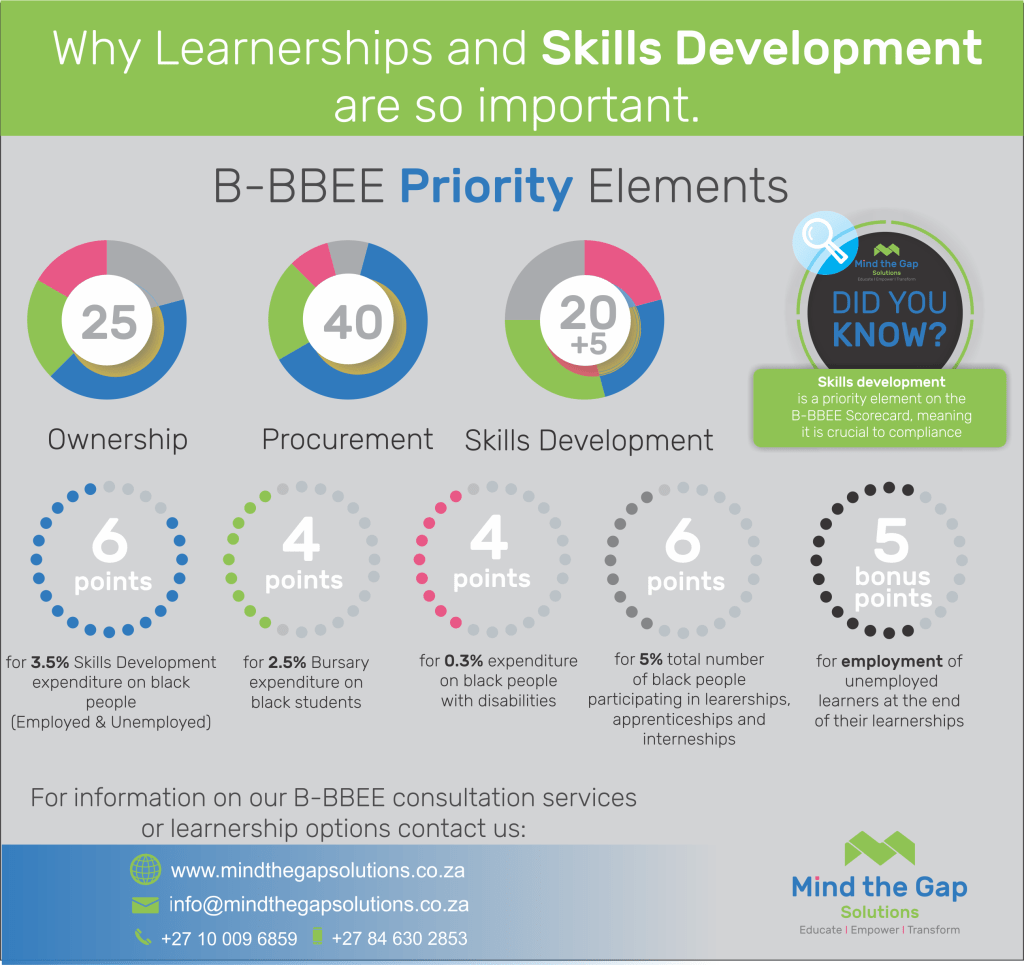
For employers, learnerships increase your B-BBEE Score on the Scorecard. As it stands, employers can benefit up to 6 points for registering black learners amounting to 5% of their headcount on learnerships.
This spend could also count toward the 3.5% leviable amount of training of black employees /learners for 6 points, and a further 2.5% for black learners with disabilities for 4 points.
There are also an additional 5 points available for absorption.
The benefits can also count for having trained employees within your workforce, which counts toward productivity and morale, without having to buy-in talent at a later date, which can be costly.
What are the consequences of non-compliance?
Skills Development is a priority element on the B-BBEE scorecard, and as such, failure to implement any form of Skills Development on the Scorecard could cause you to lose points, which in turn causes trade-sanctions and loss of opportunity for growth. Non-compliant entities also risk being dealt hefty fines.
How to implement a learnership?
Get in touch with us here. Mind the Gap Solutions has a wide range of solutions, from B-BBEE advisory, design and implementation to Skills Development and Training solutions. Let us set up a consultation session with you to better understand your needs and provide cost-effective, turnkey strategies and solutions.
 Mind The Gap Solutions